Showing posts with label green living. Show all posts

Tuesday, March 15, 2011

Tree Free and Eco Friendly Paper Products: Truly Sustainable or Just a Marketing Ploy?

In a previous life, i 'managed' a small cafe that was part of the Austin Museum of Art. I tried to encourage our purchaser to seek out as many 'eco friendly' paper items as she could find, but we had a hard time dealing with the greater cost of those goods as compared to their nasty tree-wasting competition. I was proud to serve our coffee in recycled content cups and provide cornstarch cutlery, but the cost eventually out weighed my desire to do good and our budget was slashed (along with my salary: i got laid off).

Needless to say, i was intrigued when i was contacted by the Paradigm Group:
Paradigm Group is launching a new line of “tree free” products under its Emerald Brand today.  Tree free products use bagasse – or sugar cane pulp – as the main ingredient, making these environmentally sustainable products cheaper than their traditional counterparts, without sacrificing quality.

Businesses and consumers can tap the Emerald Brand as part of their larger strategy to improve green practices at cost neutral or less than what they pay for traditional products.  So far, we’ve had corporate clients and customers actually save money by going green – contrary to popular belief. 

I don't like to accept many of the strange and often off topic advertising please that i get via email, but i was interested enough in this company's products that i conducted a brief interview with their CEO, Ralph Bianculli.  I'm always skeptical of product that are labeled as 'green,' so i had a few questions that i hoped would provide some insight on whether this company is truly sustainable, or just marketing to a specific target audience.

I first wanted a bit of history about the company.
The company began 13 years ago as a paper products company which eventually went on to merge with Georgia Pacific. The then-founder decided he wanted to research and explore sustainable products, believing that sustainability would be the wave of the future. Georgia Pacific was not so keen on exploring new materials since they already owned billions of dollars in treed forests. So, the founder started his own company which is now known as the Paradigm Group, located on Long Island, NY. He began by using 100% recycled content and began using other content about 2 years ago that is sustainably grown and harvested. These raw materials include sugar cane bagasse (the stalk leftover after sugaring) and Eucalyptus fibers. Eucalyptus regenerate themselves much more quickly than larger trees.

I immediately wanted to learn where these raw materials come from - doesn't it defeat the 'sustainability' of the renewable resource if you're then shipping it from across the world? Apparently not!
Most of their raw materials come from the far east, some being sourced in closer-to-home Mexico or Canada, with a small portion sourced domestically. Concerned about sustainability, the company has done research to judge their habit of 'out sourcing.' It turns out that the energy used to ship their raw materials and non-domestically manufactured goods via cargo ships is actually as or more eco-efficient than it would be to ship the products from the equivalent of Houston, TX to the east coast via trucks. That's pretty impressive!

I then asked about the company's sales structure: who they market to, who they are accessible to and how my readers could purchase their products:
The Paradigm Group has 3 audiences:
  1. B to B, or Business to Business: They sell their products wholesale to other businesses who then package and market them via their own brands
  2. Retail via Walgreenes. You can purchase the Walgreenes "green reed" products at most of their stores. These products are also called "department five"
  3. B to C, Business to Consumer. Everyone from home owners to small business purchasers can access the eco friendly paper products (from toilet tissue to paper plates and more) at www.EmeraldBrand.com. Sold in lower quantity 'smart packs' their products are accessible for very small consumers. You can buy the products online and have them delivered right to your door for prices that are competitive or even less than grocery store prices. A great option for those homesteaders living out in the sticks.
One very exciting detail that i learned from speaking with Ralph is that FINALLY prices are truly levelling out. Corn starch cutlery is now equal or lower in cost to the plastic competition. As the prices of resin raise, the price of corn starch stays level so you can choose 'green' options without subjecting your budget (and your employees' jobs) to slashing.

I asked one final question of Ralph:
I DO purchase paper towels on occasion and always choose Seventh Generation. How does his product compare?
In his words he claims their paper towels are more cost effective than 7th Generation and meet or exceed the quality.

I'd love to hear if you've ever tried one of these products, or if you plan to. Here's to more choices on the 'green living' front that really provide sustainable products, not just 'hip' marketing strategies.

Thursday, April 22, 2010

Happy Earth Day

Happy Earth Day, everybody. A day for people to use less energy, plant trees, and feel otherwise green and smooshy. Let's all do a little more to promote earth day every day, shall we?

This will be a short post to reflect some of the things i've done to bring Earth Day to my little homestead every day, and to muse on some of the things i'd like to do more of.

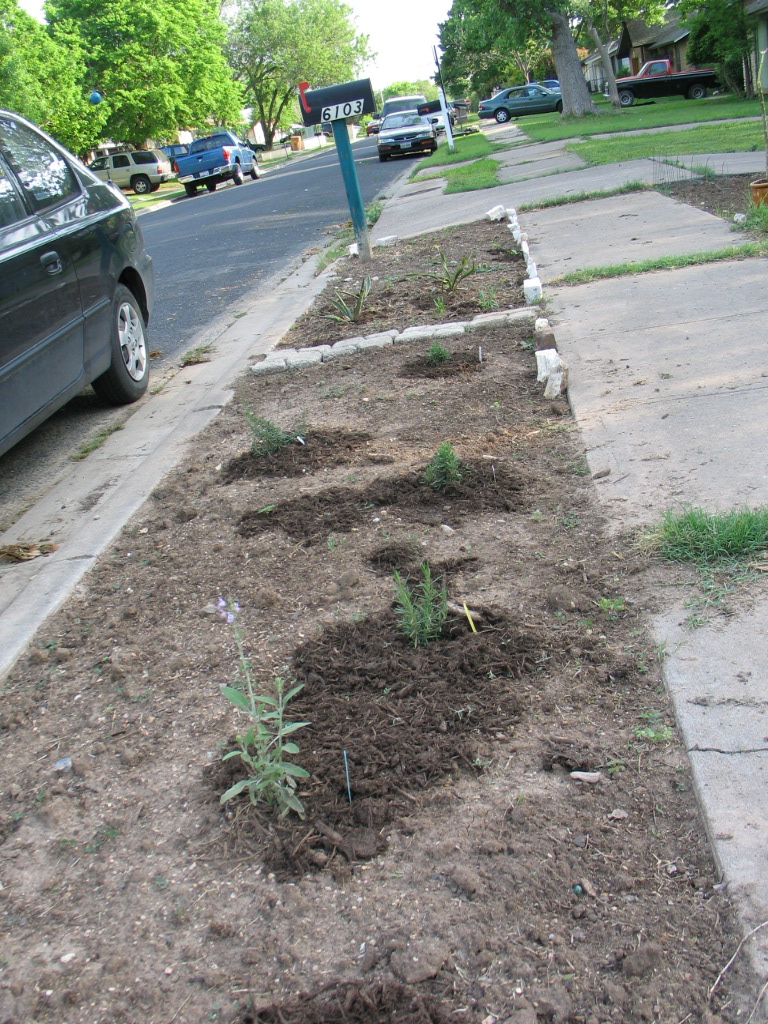
Here's my house when i bought it: nasty, yardy, chemical used (probably), toadless, anoleyless, butterflyless suburban blah, and after we dug the grass out of the street side (over the course of a month) and planted tiny little rosemary and sagelets:

Here it is now! Well, actually a few weeks ago, it's blooming even more now - but it is also raining and not sunny for photographs:


I know they're different angles, but you can get the jist! Since October of 2007 my husband and i have improved our homestead by:
  • dug  out 'strip' of lawn between sidewalk and street and planted native perennials, agaves, yuccas and wildflowers - many of which serve as habitats for beneficial insects
  • Dug out several sections of front lawn to install vegetable and herb gardens, using found and reclaimed materials, amended the soil, and welcomed the toads, skinks, and beneficial insects
  • Only irrigate food crops
  • Cultivated native plants and 'weeds' that promote beneficial insects and butterflies in the backyard
  • Practice only organic gardening methods
  • Installed a rain barrel to use captured rain water to irrigate our veggie crops
  • Built a gorgeous and prolific compost heap in the backyard that has now started feeding our gardens. We recycle all recyclables, compost all food scraps and natural fibers, and only fill 1 smallest city trash can per 2 weeks or so.
  • Certified my 'homestead' as a Wildlife Habitat trough the National Wildlife Foundation: a place where wildlife can raise young, find food and shelter, and be free of chemicals or pesticides
  • I bike places when i can and do a lot of walking, generally driving maybe a few days a week for short distances.
  • We do our best to keep our energy use low and have a thermostat that is part of our city's energy conservation plan: during high uses times it is automatically shut off.
 I feel like we've done a lot, and are repaid daily by the enjoyment that watching native plants and wildflowers grow and bloom, and insects reproduce, be born, transition, and flourish within a healthy ecosystem (complete with awesome scenes of assasin bugs eating flies and ladybugs eating aphids) brings. It is so wonderful to know i played a part in restoring the natural balance of the ecosystem surrounding my house.

However, in the future there are things we'd like to do to help restore the natural balance in our own ecosystem - we use a lot of energy despite being frugal, and there are some things i'd like to do to help with that:
  • Install solar panels to power things like electric fences, water pumps, out buildings, water heaters, etc
  • Wind power perhaps? Depending on where we move, perhaps we could have a wind turbine to help power some things, but perhaps that's beyond our scope.
  • Grey water collection: i desperately want a grey water collection system set up - either to redirect it to gardens, or to be filtered and reusable in other ways. (grey water would include sink and shower water waste)
  • More rain barrels! I want a better system, particularly in its orientation. My present rain barrel is down hill from my veggie garden, which means i have to use a watering can and walk back and forth a million times. I'd like to set up a system that can use gravity to automatically irrigate our veggies and herbs. Perhaps also setting up certain barrels to filter the water to potability standards for our livestock.
  • We desperately need to add more insulation to our attic and get better windows and doors - the seals are all off due to our foundation troubles and i'm sure our energy use would be lessened with more insulation.
  • I already grow a lot of our food, but i'd really like to grow a larger percentage so that we rely less on food that is grown more than a few miles from our house. I'm doing well in this regard, but could do much better!
Enjoy Earth Day, everyone. Let me know what you'll be doing this next year to reduce your (negative) impact on this earth as a human being. We're very destructive animals with the greatest capacity for domination over the rest of the world - let's take that power into our own hands and use it for good!

-Miranda